Dual Column Nutrition Facts Label
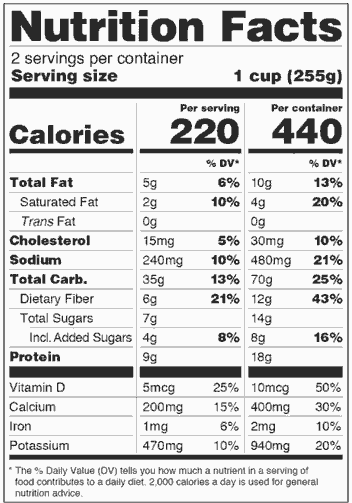
Required when a package sold individually, or one unit, holds 200% to 300% of its reference amount. The label shows a column per serving and a column for the whole package or unit.
On the package
- 850 mL
- One bottle, sold alone
- 360 mL
- Reference amount for sweetened tea
- 236%
- Needs a per bottle column
Why this format
A bottle of iced tea sold on its own. The 850 mL bottle holds 236% of its reference amount. It needs a per serving column and a per bottle column. A smaller bottle at 180% is one serving, with an optional household measure column.
§ 101.9(b)(12)(i)An invented product, for illustration.
The label, part by part
Hover or tap a part.Tap a part.
Nutrition Facts
*The % Daily Value (DV) tells you how much a nutrient in a serving of food contributes to a daily diet. 2,000 calories a day is used for general nutrition advice.
An 850 mL bottle of peach iced tea. Invented values, rounded the FDA way.
FDA’s sample
Whole panel
Rules for the panel as a whole: space and bold type.
Wider than the standard vertical panel, about one column more.
- “Total carb.” and “Incl.” are allowed on dual column panels
Short names
“Total carb.” and “Incl.” are allowed on dual column panels
Rule text § 101.9(j)(13)(ii)(B)
In words
Wider than the standard vertical panel, about one column more.
Heading
The title at the top of the panel.
- “Nutrition Facts” heading No smaller than any other type, except the calorie number
“Nutrition Facts” heading
No smaller than any other type, except the calorie number
Rule text § 101.9(d)(2)
Serving
How many servings the package holds, and how big one is.
- 10 pt
- 10 pt, bold
Calories
The calories in one serving, and in the package.
Two headings, two numbers § 101.9(e)(6)(i) From FDA’s sample
- 16 pt, bold
- 22 pt, bold
- “Amount per serving” Not required on a dual column panel
- Column headings Accurately describe the amount each column covers
- 6 pt
Nutrients
Fat, cholesterol, sodium, carbohydrate and protein, with the %DV where there is one.
Two columns, split by lines § 101.9(e)(6)
- 8 pt
- 6 pt
- Columns Amounts and %DV in two columns, split by vertical lines
Vitamins and minerals
Vitamin D, calcium, iron and potassium, plus any others you list.
Two columns too § 101.9(e)(6)
- 8 pt
- Vitamins and minerals Listed vertically, not side by side
Footnote
The note at the bottom that says what %DV means.
- 6 pt
?
Rule text
From FDA’s sample
BetterMenu’s choice
Do I need this?
These pages are for conventional foods and drinks, not dietary supplements or medical foods.
Studio works out the per-serving and per-package numbers from your recipe today. It exports the standard vertical panel. Dual column export is not available yet. Studio gives the numbers for both columns, and your designer sets them in the dual column layout. Open Studio
In detail
Is my package 200% to 300% of its reference amount?
An 850 mL bottle of iced tea. The reference amount for sweetened tea is 360 mL. 850 ÷ 360 × 100 = 236%. That is between 200% and 300%, so the label needs a per serving column and a per bottle column.
One 250 g muffin. The reference amount for muffins is 110 g. 250 ÷ 110 × 100 = 227%, so the label needs a per serving column and a per muffin column.
A 600 mL bottle is 600 ÷ 360 × 100 = 167%. Under 200%, it is one serving, with no second column required.
§ 101.9(b)(12)(i) Find your reference amountWhen a second column is required, and when it is not
Per serving and per package
Required when a package sold individually holds 200% to 300% of the reference amount. The second column covers the whole package.
§ 101.9(b)(12)(i)Per serving and per unit
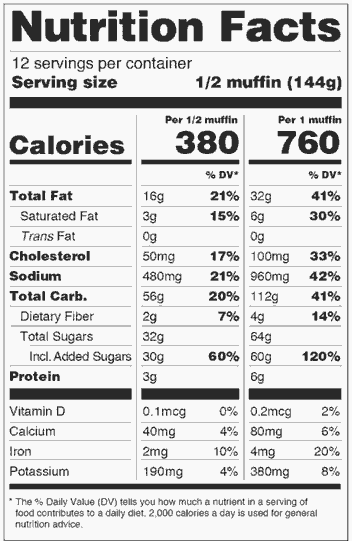
Required when one unit, such as one muffin, weighs 200% to 300% of the reference amount. The serving size is the amount closest to the reference amount, and the second column covers one unit. The same exemptions apply as for the per-package column.
§ 101.9(b)(2)(i)(D)When no second column is required
A product that qualifies for the small-package tabular or linear label.
Raw fruits, vegetables and seafood with voluntary labeling or claims.
A label that already adds an as prepared column, a column for two Daily Value groups, or a per cup popped column for popcorn. Random weight products too.
§ 101.9(b)(12)(i)(A)§ 101.9(b)(12)(i)(B)§ 101.9(b)(12)(i)(C)§ 101.9(b)(8)(iii)Over 150% and under 200%
The whole package is one serving. You may add a column per common household measure, such as per cup, to the left of the per package column.
§ 101.9(b)(6)Common mistakes
-
Wrong: Treating a package of 150% to 200% as two servings.
Right: Label it as one serving.
§ 101.9(b)(6) -
Wrong: Leaving out the vertical lines between the columns.
Right: Split the columns with vertical lines.
§ 101.9(e)(6) -
Wrong: Treating the second column as required on a small package that qualifies for the small-package tabular label.
Right: One column is enough there. A second is your choice.
§ 101.9(b)(12)(i)(A)
Rule text and sources
“Products that are packaged and sold individually and that contain at least 200 percent and up to and including 300 percent of the applicable reference amount must provide an additional column within the Nutrition Facts label that lists the quantitative amounts and percent Daily Values for the entire package, as well as a column listing the quantitative amounts and percent Daily Values for a serving that is less than the entire package (i.e., the serving size derived from the reference amount).”
“If a unit weighs at least 200 percent and up to and including 300 percent of the applicable reference amount, the serving size shall be the amount that approximates the reference amount. In addition to providing a column within the Nutrition Facts label that lists the quantitative amounts and percent Daily Values per serving size, the manufacturer shall provide a column within the Nutrition Facts label that lists the quantitative amounts and percent Daily Values per individual unit. The first column would be based on the serving size for the product and the second column would be based on the individual unit. The exemptions in paragraphs (b)(12)(i)(A), (B), and (C) of this section apply to this provision.”
“When dual labeling is presented for a food on a per serving basis and per container basis as required in paragraph (b)(12)(i) of this section or on a per serving basis and per unit basis as required in paragraph (b)(2)(i)(D) of this section, the quantitative information by weight as required in paragraph (d)(7)(i) and the percent Daily Value as required in paragraph (d)(7)(ii) shall be presented in two columns, and the columns shall be separated by vertical lines as shown in the displays in paragraph (e)(6)(i) of this section.”
“A product that is packaged and sold individually that contains less than 200 percent of the applicable reference amount must be considered to be a single-serving container, and the entire content of the product must be labeled as one serving.”
“In addition to providing a column within the Nutrition Facts label that lists the quantitative amounts and percent Daily Values per serving, for a product that is packaged and sold individually that contains more than 150 percent and less than 200 percent of the applicable reference amount, the Nutrition Facts label may voluntarily provide, to the left of the column that provides nutrition information per container (i.e., per serving), an additional column that lists the quantitative amounts and percent Daily Values per common household measure that most closely approximates the reference amount.”
“This provision does not apply to products that meet the requirements to use the tabular format in paragraph (j)(13)(ii)(A)(1) of this section or to products that meet the requirements to use the linear format in paragraph (j)(13)(ii)(A)(2) of this section.”
“This provision does not apply to raw fruits, vegetables, and seafood for which voluntary nutrition labeling is provided in the product labeling or advertising or when claims are made about the product.”
“This provision does not apply to products that require further preparation and provide an additional column of nutrition information under paragraph (e) of this section, to products that are commonly consumed in combination with another food and provide an additional column of nutrition information under paragraph (e) of this section, to products that provide an additional column of nutrition information for two or more groups for which RDIs are established (e.g., both infants and children less than 4 years of age), to popcorn products that provide an additional column of nutrition information per 1 cup popped popcorn, or to varied-weight products covered under paragraph (b)(8)(iii) of this section.”
“For random weight products, manufacturers may declare “varied” for the number of servings per container provided the nutrition information is based on the reference amount expressed in the appropriate household measure based on the hierarchy described in paragraph (b)(5) of this section.”
- The rule: FDA, 21 CFR 101.9, eCFR as of 2026-02-12
- FDA sample label, Per serving and per container: 83 FR 65493
- FDA sample label, Per serving and per unit: 83 FR 65493
- The same facts as data: Dual column as JSON
- Paragraphs cited on this page § 101.9(b)(12)(i)§ 101.9(b)(2)(i)(D)§ 101.9(e)(6)§ 101.9(e)(6)(i)§ 101.9(b)(12)(i)(A)§ 101.9(b)(12)(i)(B)§ 101.9(b)(12)(i)(C)§ 101.9(b)(8)(iii)§ 101.9(b)(6)§ 101.9(e)(6)(ii)§ 101.9(j)(13)(ii)(B)§ 101.9(c)(2)(i)§ 101.9(c)(2)(ii)
Related formats
Questions
When is a dual column Nutrition Facts label required?
When a package sold on its own holds 200% to 300% of its reference amount, or when one unit weighs 200% to 300%.
What about a package under 200% of the reference amount?
A package sold individually with less than 200% is a single-serving container. The whole package is labeled as one serving. Over 150%, you may add a per household measure column to its left.
Which products need no second column?
Products that qualify for the small-package tabular or linear label. Raw produce and seafood labeled voluntarily. Labels that already add an as prepared, two-group or per cup popped column, and random weight products.
How do I work out the percentage?
Divide the amount in one package, or one unit, by its reference amount and multiply by 100. An 850 mL bottle of iced tea, with the 360 mL reference amount for sweetened tea in 21 CFR 101.12(b), is 850 ÷ 360 × 100 = 236%. That is between 200% and 300%, so it needs the second column.
Can a dual column label be tabular?
Yes. FDA shows a tabular panel with both columns.
Can a dual column panel shorten nutrient names?
Yes. From FDA’s abbreviation list, only “Total carb.” and “Incl.” on a package over 40 sq in, on dual column displays. A package of 40 sq in or less may use every short name on that list. Any panel may print “Saturated fat” as “Saturated” and “Trans fat” as “Trans”.
Every label format, and which one you need
For information only. Check the sources before printing a label.