Nutrition Facts Label for Infant Foods
Foods made for infants through 12 months, other than infant formula, use infant Daily Values. The panel shows no %DV for seven nutrients and has no footnote.
On the package
- 6+ months
- Made for infants
- 7 rows
- With no %DV
- None
- Footnote
Why this format
A pouch of pureed pears for babies 6 months and up. The pouch is made for infants only. It uses the infant panel, with infant Daily Values, no %DV for the seven nutrients and no footnote.
§ 101.9(j)(5)(ii)An invented product, for illustration.
The label, part by part
Hover or tap a part.Tap a part.
Nutrition Facts
Vitamin D 0mcg0%
Calcium 10mg4%
Iron 0.3mg2%
Potassium 130mg20%
No footnote on this label.
A 4 oz pouch of pureed pears for infants. Invented values, rounded the FDA way.
FDA’s sample
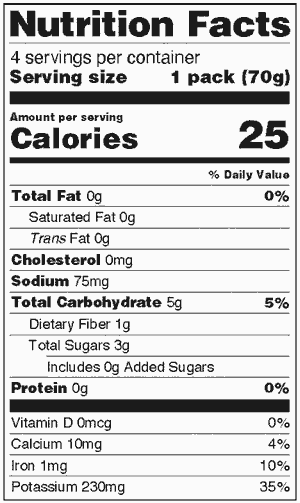
Whole panel
Rules for the panel as a whole: space and bold type.
The same as the standard vertical panel, with no footnote.
“Nutrition Facts”, “Serving size”, “Amount per serving”, “% Daily Value”, the names of nutrients that are not indented and the %DV figures. The calorie number and the serving size line are bold too. Servings per container is not.
Total Sugars 11g
Total Sugars 11g
In words
The same as the standard vertical panel, with no footnote.
Bold. “Nutrition Facts”, “Serving size”, “Amount per serving”, “% Daily Value”, the names of nutrients that are not indented and the %DV figures. The calorie number and the serving size line are bold too. Servings per container is not. § 101.9(d)(1)(iv)§ 101.9(d)(1)(iii)§ 101.9(d)(3)(ii)
Heading
The title at the top of the panel.
- “Nutrition Facts” heading No smaller than any other type, except the calorie number
“Nutrition Facts” heading
No smaller than any other type, except the calorie number
Rule text § 101.9(d)(2)
Serving
How many servings the package holds, and how big one is.
- 10 pt
- 10 pt, bold
Calories
The calories in one serving.
- 16 pt, bold
- 22 pt, bold
- 6 pt
Nutrients
Fat, cholesterol, sodium, carbohydrate and protein, with the %DV where there is one.
No %DV on seven rows § 101.9(j)(5)(ii)(A)
- 8 pt
- 6 pt
- None for saturated fat, trans fat, cholesterol, sodium, fiber, total and added sugars
%DV
None for saturated fat, trans fat, cholesterol, sodium, fiber, total and added sugars
Rule text § 101.9(j)(5)(ii)(A)
Vitamins and minerals
Vitamin D, calcium, iron and potassium, plus any others you list.
Infant Daily Values § 101.9(c)(8)(i)
- 8 pt
Footnote
An infant label has no footnote.
Not on this label.
?
Rule text
From FDA’s sample
BetterMenu’s choice
Do I need this?
These pages are for conventional foods and drinks, not dietary supplements or medical foods.
Studio works out the per-serving and per-package numbers from your recipe today. It exports the standard vertical panel. Infants through 12 months export is not available yet. Studio gives the amounts per serving, and your designer sets them in the infant panel with the infant Daily Values. Open Studio
In detail
Their Daily Values, beside the adult ones
| Nutrient | Adults 4+ | Infants | Change |
|---|---|---|---|
| Total Fat | 78 g | 30 g | Lower |
| Saturated Fat | 20 g | – | No %DV |
| Cholesterol | 300 mg | – | No %DV |
| Sodium | 2,300 mg | – | No %DV |
| Total Carbohydrate | 275 g | 95 g | Lower |
| Dietary Fiber | 28 g | – | No %DV |
| Added Sugars | 50 g | – | No %DV |
| Protein | 50 g | 11 g | Lower |
| Vitamin D | 20 mcg | 10 mcg | Lower |
| Calcium | 1,300 mg | 260 mg | Lower |
| Iron | 18 mg | 11 mg | Lower |
| Potassium | 4,700 mg | 700 mg | Lower |
Infants and children 1 through 3
A food made for both infants through 12 months and children 1 through 3 shows two %DV columns, one for each group.
A package that holds 200% to 300% of its reference amount then needs no per-package column.
§ 101.9(c)(8)(i)§ 101.9(e)§ 101.9(b)(12)(i)(C)The protein %DV on an infant label
- A food for infants gives a %DV for protein, even with no protein claim. § 101.9(c)(7)(i)
- Except when its protein quality (PER) is under 40% of casein. Then the label gives no protein %DV. § 101.9(c)(7)(i)
- It says “not a significant source of protein” beside the grams instead. § 101.9(c)(7)
- The %DV uses the corrected protein: grams of protein times its PER divided by the PER of casein, never above 1.00. § 101.9(c)(7)(ii)
- The infant RDI for protein is 11 g. § 101.9(c)(7)(iii)
Common mistakes
-
Wrong: Printing a %DV for any of the seven nutrients that show none on an infant label, such as sodium or added sugars.
Right: Leave the %DV off those seven rows.
§ 101.9(j)(5)(ii)(A) -
Wrong: Keeping the adult footnote.
Right: Print no footnote.
§ 101.9(j)(5)(ii)(A) -
Wrong: Using adult Daily Values for the %DV.
Right: Use the infant Daily Values.
§ 101.9(c)(8)(i)
Rule text and sources
“Such labeling shall not declare a percent Daily Value for saturated fat, trans fat, cholesterol, sodium, dietary fiber, total sugars, or added sugars and shall not include a footnote.”
“For purposes of declaration of percent of Daily Value as provided for in paragraphs (d), (e), and (f) of this section, foods represented or purported to be specifically for infants through 12 months, children 1 through 3 years, pregnant women, and lactating women shall use the RDIs that are specified for the intended group.”
“For foods represented or purported to be specifically for both infants through 12 months of age and children 1 through 3 years of age, the percent of Daily Value shall be presented by separate declarations according to paragraph (e) of this section based on the RDI values for infants through 12 months of age and children 1 through 3 years of age.”
“This provision does not apply to products that require further preparation and provide an additional column of nutrition information under paragraph (e) of this section, to products that are commonly consumed in combination with another food and provide an additional column of nutrition information under paragraph (e) of this section, to products that provide an additional column of nutrition information for two or more groups for which RDIs are established (e.g., both infants and children less than 4 years of age), to popcorn products that provide an additional column of nutrition information per 1 cup popped popcorn, or to varied-weight products covered under paragraph (b)(8)(iii) of this section.”
- The rule: FDA, 21 CFR 101.9, eCFR as of 2026-02-12
- FDA sample label, Infants through 12 months: 88 FR 17710
- The same facts as data: Infants through 12 months as JSON
- Paragraphs cited on this page § 101.9(j)(5)(ii)§ 101.9(j)(5)(ii)(A)§ 101.9(c)(8)(i)§ 101.9(e)§ 101.9(b)(12)(i)(C)§ 101.9(j)(5)(i)§ 101.9(j)(5)(ii)(B)
Related formats
Questions
Which nutrients show no %DV on an infant food label?
Saturated fat, trans fat, cholesterol, sodium, dietary fiber, total sugars and added sugars. The label still lists their amounts.
Does an infant food label have a footnote?
No. The rule for infant foods says the label shall not include a footnote.
Does this label apply to infant formula?
No. The rule covers foods for infants other than infant formula.
What if the food is for infants and children 1 through 3?
The label shows two %DV columns, one per group, each from its own Daily Values.
Every label format, and which one you need
For information only. Check the sources before printing a label.